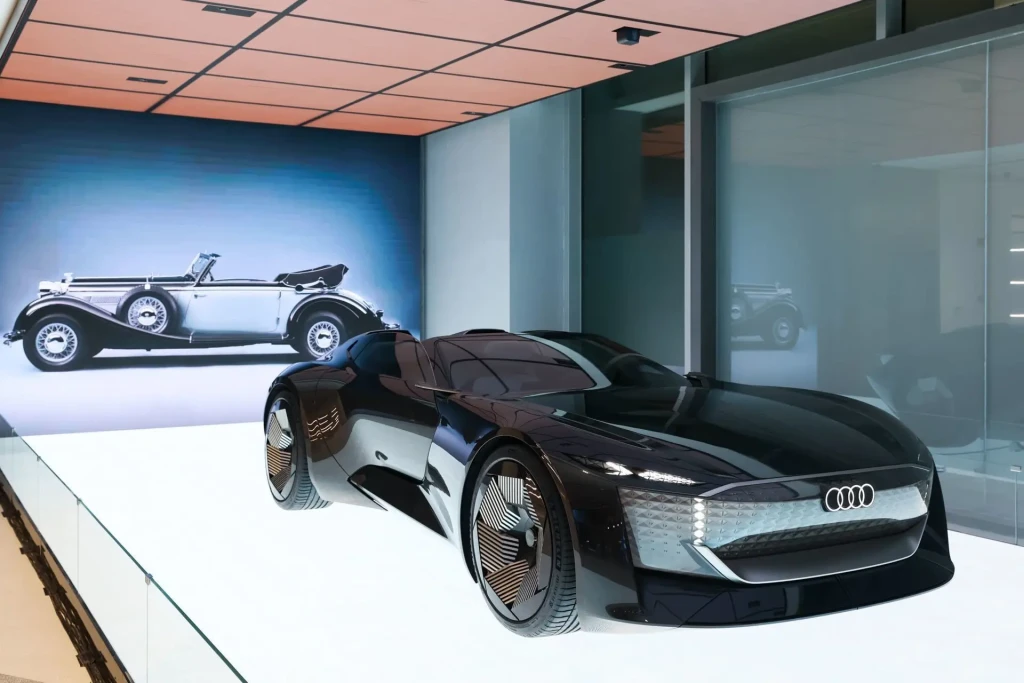
Inside Audi's Shanghai Flagship Store: A 54m² LED Floor Display That Doubles as a Car Stage

XYGLED built a 54-square-meter, P3.91 indoor LED floor display for the Audi flagship store at Shanghai Auto Industry Building. The screen replaces a static showroom platform: every time a new vehicle is rolled in, it’s parked directly on top of the display, turning the car itself into the centerpiece of a full-floor visual stage.

audi-flagship-store-led-floor-display-shanghai-01.jpg

This case study covers the brief, the product selected, and why a sheet metal LED floor display was the right fit for a luxury automotive showroom.

Project Snapshot

DetailSpecification
ClientAudi flagship store
LocationShanghai Auto Industry Building, Shanghai, China
ApplicationIndoor showroom car display platform
ProductXYGLED A-XM Series — Indoor Sheet Metal LED Floor Display
Screen area54 m²
Pixel pitchP3.91
InteractivityNon-interactive (content-driven display)
Cabinet structureSheet metal, load-bearing
Primary use caseVehicle display platform for new model launches
audi-showroom-car-display-led-floor-screen-02.jpg

The Challenge: A Showroom Floor That Works as Hard as the Cars On It

Audi’s flagship store sits inside Shanghai Auto Industry Building, a high-traffic destination for car buyers and industry visitors. A conventional showroom platform can hold a car, but it can’t tell a story around it.

The dealership needed a floor surface that could do two things at once. First, it had to support the physical weight and rolling load of full-size vehicles, day after day, without any loss of flatness or panel integrity. Second, it had to function as a visual stage — capable of displaying brand graphics, lighting effects, and product-launch content directly beneath the car.

A static floor could not deliver the second requirement. A fragile display could not survive the first. XYGLED’s brief was to solve for both.

XYGLED supplied a 54m² LED floor display built on the A-XM Series, an indoor sheet metal floor display line designed for exactly this kind of load-bearing, high-traffic retail application.

xygled-a-xm-series-p3-91-sheet-metal-led-floor-01.jpg

Why sheet metal cabinets

The A-XM Series uses a sheet metal cabinet structure rather than a standard indoor cabinet. This gives the floor the structural rigidity needed to carry vehicle weight without flexing, while keeping the panel seams tight enough to maintain a flat, seamless walking and driving surface.

Why P3.91 pixel pitch

At 54m², the display needed a pixel pitch fine enough for close-up viewing — showroom visitors walk directly around and past the screen — but efficient enough to run reliably at this scale. P3.91 strikes that balance for indoor retail and showroom environments, delivering clear brand visuals and video content without the cost overhead of an ultra-fine pitch that the viewing distance doesn’t require.

Why non-interactive

Unlike interactive LED floor screens used for entertainment or gaming, this installation is intentionally non-interactive. The screen’s job is not to respond to foot traffic — it is to serve as a controlled visual backdrop for the vehicle parked on top of it. Content is programmed and triggered by the dealership team, not by visitor movement.

How the Display Is Used

Every time Audi introduces a new model at this location, the vehicle is driven onto the LED floor and parked in place. The floor then becomes part of the presentation:

  • Brand-specific lighting and color washes frame the vehicle from below and around it.
  • Launch graphics and model information can run on the surrounding floor area while the car remains stationary.
  • The display can be reprogrammed for each new vehicle rotation, so the showroom stage changes with every launch without any physical rebuild.

This turns a fixed showroom footprint into a flexible presentation space — the car changes, and the stage changes with it.

Why XYGLED for This Project

XYGLED manufactures LED floor displays on a dedicated automated production line built specifically for this product category, which supports the load-bearing and flatness tolerances that automotive showroom applications require. For a flagship retail environment like this one, the display had to meet luxury-brand visual standards while surviving daily vehicle loading — a combination that depends on cabinet engineering as much as on pixel pitch.

Frequently Asked Questions

An LED floor display replaces a static platform with a programmable visual surface. In automotive retail, it is typically used to stage new vehicle launches, run brand lighting effects around a parked car, and display model information directly on the showroom floor.

Yes, when built with a load-bearing sheet metal or aluminum cabinet structure designed for vehicle loads. The A-XM Series uses a sheet metal cabinet specifically to support this kind of rolling and static vehicle weight indoors.

The right pixel pitch depends on viewing distance and screen size. For close-up indoor retail viewing, such as a showroom floor visitors walk around, a fine pitch like P3.91 is commonly used to balance image clarity with cost and power efficiency.

No. Interactive floor displays use sensors to respond to movement, which suits entertainment or gamified retail activations. Non-interactive floor displays, like the one installed in this Audi showroom, are used purely as a programmable visual stage and are simpler to maintain in high-traffic commercial environments.

XYGLED designs and manufactures indoor and outdoor LED display solutions, including load-bearing LED floor screens for retail, automotive, and event applications. [Contact XYGLED] to discuss a custom LED floor display project.

Related Products

Related Case Studies

error: Content is protected !!